

Once you've covered the small-room basics — clear the floor, keep the palette light, don't buy the enormous wardrobe — the gains get harder to find. What's left is the creative half: pieces that do two jobs instead of one, and tricks that change how big the room reads without changing a single dimension. These 25 creative bedroom ideas for small spaces lean into clever rather than merely tidy.
Worth saying up front: a small bedroom is not a design problem to be solved once. It's a set of trade-offs. Every centimetre you give to storage, you take from circulation. Every surface you add, you have to keep clear. The ideas below are worth doing because they buy you something back — and the three sections that follow explain what each one is actually buying.
Fool the eye — and know how much it's worth
Visual tricks get oversold. A mirror will not make a 7 m² room feel like 12. What optical moves genuinely do is remove the visual interruptions that make a room read as cramped, and that is a real effect worth having.
The most reliable one is height. Curtains hung close above the window frame chop the wall into segments and stop the eye low; hung 10–15 cm below the ceiling and extended 15–25 cm past the frame on each side, they pull the eye up and let the window keep its full glass when open. Nothing about the room changed except where two brackets went.
The second is continuity. A small room with four different flooring transitions, three rug edges and a dark plinth reads as chopped up. Reduce the number of visual breaks — same floor throughout, one rug rather than two, skirting close to the wall colour — and the eye runs further before it stops.
Mirrors work on a narrower rule than most advice admits: they reflect whatever faces them. Positioned to catch a window or perpendicular to it, a mirror puts daylight back into the room's dark side. Positioned to face the doorway or a cluttered corner, it just doubles the clutter — and a large mirror directly facing the bed is something a lot of people find unsettling at night.
Double up — the only way to add function without adding footprint
This is where the real space comes from. In a small bedroom every large object should justify its floor area twice.
Under-bed storage is the biggest single win, because that area is dead space by default: a standard bed frame leaves 15–30 cm of clearance, and a queen mattress at 152×203 cm means roughly 3 m² of floor doing nothing. Lidded bins on castors turn it into off-season storage; a platform bed with integrated drawers turns it into a chest of drawers you didn't have to stand anywhere.
A bookshelf headboard replaces the nightstand you have no floor for. A wall-mounted lamp does the same for the surface the lamp would otherwise occupy — a swing-arm fixture at roughly shoulder height when sitting up frees the entire top of the nightstand for the things you actually reach for.
Fold-down desks deserve their reputation, with one caveat: 40–45 cm of depth is enough for a laptop and a mug, and not enough for a monitor. Decide which one you're building before you fix the bracket to the wall.
And the least glamorous double-up of all: sliding or bifold wardrobe doors. A hinged door needs its own swing arc — around a square metre of floor that must stay permanently empty. In a 9 m² room that is over a tenth of the floor spent on a door.
Zone without walls — one room, several jobs
Most small bedrooms are asked to be more than bedrooms: an office, a dressing room, sometimes the only place to sit. Zoning is how you let them do that without a partition eating the floor.
Three tools do almost all the work. A rug defines the sleep zone by outlining it — sized so it extends at least 45–60 cm past the sides of the bed, or it reads as a bath mat. Lighting separates activities: a bright, cool task light over the desk and a warm 2700 K lamp by the bed tell your eye — and your body clock — which mode the room is in. And furniture orientation does the rest: a desk turned to face away from the bed makes a different room out of the same corner than one pushed against the footboard.
Keep one rule above all of it: protect the walkway. A comfortable path beside the bed is 60–75 cm; below about 55 cm you're turning sideways every night. Anything that narrows that path — however clever — costs more than it gives.
25 creative small-space ideas — and why each works

1. Light Colour Palette
Pale walls reflect light and recede, the simplest trick to make a small room read open and airy.

2. Vertical Shelving
Storing up the walls keeps the floor clear — the creative use of space most rooms forget.

3. Mirrored Accents
A mirror bouncing daylight visually doubles the room — the oldest space trick, and still the best.

4. Floating Nightstands
Wall-mounted frees the floor beneath and keeps sightlines open — set it at mattress height.

5. Under-Bed Storage
Reclaim the biggest dead space in the room with lidded, easy-slide bins.

6. Layered Lighting
Bedside lamps plus string lights beat one overhead bulb — keep them warm at 2700 K.

7. Rugs to Define Space
A rug zones the sleep area, letting one small room clearly do more than one job.

8. Multi-Functional Furniture
Every large piece should multitask — a desk-plus-storage earns its footprint twice over.

9. Plants by the Window
Group greenery where it gets light but clear of the walkway, so it freshens without crowding.

10. Wall Art
Decorate the walls, not the floor — personality without any footprint cost.

11. Height-Enhancing Curtains
Hang curtains high and wide to make the wall — and the whole room — read taller.

12. Zones by Arrangement
Position furniture to carve sleep, work and seating zones without adding a single wall.

13. Narrow Desk
A slim desk gives you a real workspace while barely touching the walkway.

14. Built-In Wardrobe
Built-ins fit awkward dimensions exactly, reclaiming every centimetre a freestanding unit wastes.

15. Bookshelf Headboard
A headboard that stores books replaces the nightstand where there's no floor for one.

16. Accent Wall
One bold wall adds depth and a focal point without closing the room in.
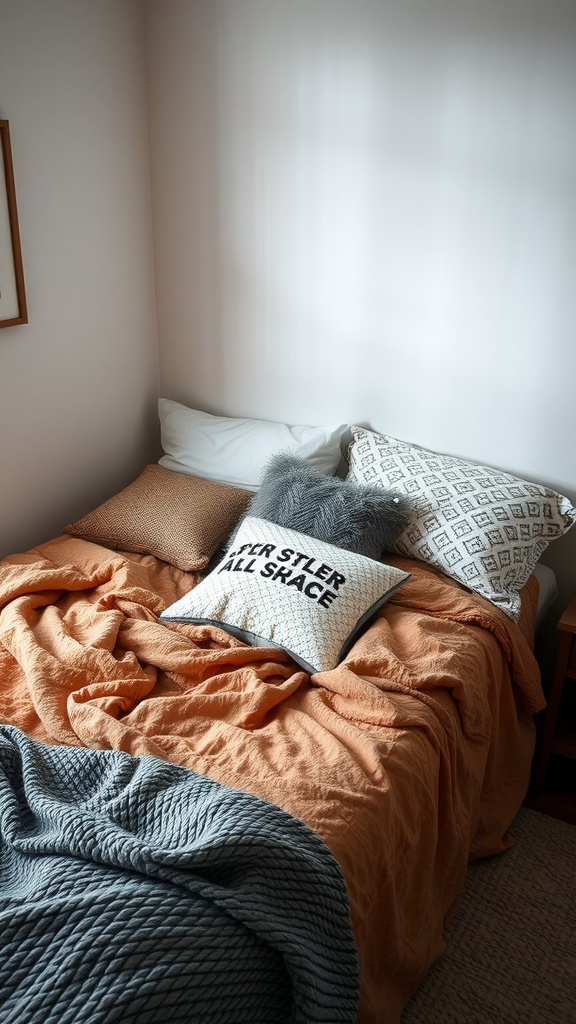
17. Textured Fabrics
Texture adds richness without bulk — depth for free in a room with no space to spare.

18. Themed Cohesion
A single consistent theme makes a small room feel intentional rather than piecemeal.

19. Closet-Door Storage
Over-door and inside-door organisers turn the closet door itself into usable storage.

20. A Cosy Nook
A chair by the window turns a corner into a retreat — creative use of the least-used spot.

21. Foldable Furniture
Folding tables and chairs appear when needed and vanish when not — flexibility in tight quarters.

22. Customisable Wall Panels
Modular panels behind the bed add a headboard and function you can reconfigure over time.

23. Decorative Baskets
Baskets store and look good, so storage doubles as decor in a room that shows everything.

24. Personalised Lighting
A characterful fixture becomes a small room's jewellery — one statement instead of clutter.

25. Corner Furniture
Corner-fit shelving and tables claim the least-used square footage without narrowing the path.
Which move to make first — a five-minute diagnosis
Twenty-five ideas is a menu, not a plan. Small rooms fail in four distinct ways, and the fix that transforms one room does nothing for another. Stand in the doorway and work out which of these you actually have.
The room has no floor left. You can see the bed, and beyond it a narrow channel. Go vertical and go wall-mounted: floating nightstands, wall lamps instead of table lamps, shelving above the bed rather than beside it, storage that hangs. Anything that touches the floor should either be the bed or be earning its footprint twice.
The room has no walls left. Two doors, a window and a radiator, and nowhere continuous to put anything. Stop trying to place furniture around the perimeter and commit one wall to a single tall, shallow run — 30 cm deep is enough for most storage that isn't hanging clothes. Fragmented storage on four walls always reads busier than one deliberate block.
The room has no light. One small window, or a north aspect, and the room feels closed even when it's tidy. This is where the optical tricks genuinely earn their keep: mirror perpendicular to the window, pale and matte on the largest surfaces, curtains that clear the glass completely when open, and three separate light sources rather than one ceiling fitting.
The room has no storage. Everything is out because there's nowhere to put it. Nothing here works until that changes — start under the bed, then the headboard, then the wardrobe doors. Decoration applied to a room with an unsolved storage problem lasts about a week.
Most small bedrooms have two of the four. Fix them in that order and the remaining ideas become decoration rather than damage control.
Common mistakes
Buying a smaller bed to gain floor. The most frequently regretted small-room decision. You spend a third of your life on that mattress and the reclaimed 20 cm gets filled with something you care about far less. Shrink the wardrobe instead.
Several small pieces instead of one larger one. Three narrow units read as clutter; one taller unit of the same total volume reads as architecture. Fewer objects, each doing more, is the whole principle.
Furniture pushed against every wall. It feels like the space-saving move and usually isn't — it leaves a hole in the middle and blocks the walkway at the same time. One committed wall beats four half-used ones.
All-white, no texture. Pale surfaces do reflect light, but a room with nothing but flat white reads as unfinished rather than airy. Keep the palette light and let texture — linen, wood, a woven shade — carry the interest.
Storage you have to unpack to use. Bins stacked three deep under the bed are a storage idea, not storage. If retrieving winter jumpers means emptying two boxes onto the mattress, you'll stop doing it by November.
Final thought
Creative small-space design isn't about squeezing in more. It's about pieces that do double duty, and about removing the visual interruptions that make a room read smaller than it measures. Clever beats crammed every time.
The test is simple and it isn't visual: after a fortnight, is the room still like this? A small bedroom that only works when it's perfectly tidy hasn't been solved — it's been staged. The ideas worth keeping are the ones that survive an ordinary Tuesday.

Sources & principles referenced
- Curtain hanging heights and widths relative to the window frame, and their effect on perceived wall height.
- Mirror placement relative to daylight sources rather than to the viewer.
- Standard bed frame clearances (15–30 cm) and mattress dimensions as the basis for under-bed storage volume.
- Circulation widths beside a bed: 60–75 cm comfortable, below 55 cm restrictive.
- Hinged versus sliding wardrobe doors and the floor area a door swing removes from use.
- Desk depths of 40–45 cm as the practical minimum for laptop work.
- Rug sizing extending 45–60 cm beyond the bed to define a sleep zone.
- Warm 2700 K light for rest and cooler task lighting for work as a zoning device.
- Visual continuity: reducing the number of floor and trim transitions in a small room.