
The irony of a minimalist kitchen is that the title of most articles about it — "essential decor items" — misses the point. A minimalist kitchen isn't built by adding the right objects; it's built by removing the wrong ones and keeping only what earns its place. These 28 minimalist kitchen ideas are really a set of decisions about what to leave out, plus the few things genuinely worth putting on show in a minimalist kitchen.
Minimalism is a discipline, not a shopping list
A minimalist kitchen is defined by clear surfaces, hidden storage, a restrained palette and honest materials — none of which you buy. The single decision underneath all of it is this: every object left visible must justify its place by being used, beautiful, or both. A dated kettle used daily fails the "beautiful" test but passes on use — so choose one you like looking at. A decorative bowl used never fails on use, so it goes in a cupboard.
Apply that filter honestly and a minimalist kitchen more or less designs itself. Skip it, and you end up with an expensive kitchen cluttered with "essential" objects that defeat the entire aesthetic.
The one-third countertop rule
Clear worktops are the defining feature, but "clear" doesn't mean bare. A workable discipline: keep the largest continuous stretch of worktop entirely empty for actual cooking, and confine anything on display to one grouped zone. Only appliances used at least weekly earn permanent countertop space — everything else lives behind a cupboard door.
Texture does the work colour usually would
The most common failure in minimalist kitchens is flatness — a room so pared back it reads as cold and lifeless. The fix isn't colour; it's texture. Wood grain against matte cabinetry, honed stone against smooth ceramic, linen against metal. In a two- or three-colour scheme, contrasting textures are what give the room depth and stop minimalism tipping into austerity.
Storage is what makes it possible
Clear surfaces only exist if everything has somewhere to go. That makes generous concealed storage the structural requirement behind the whole look. Integrated appliances behind matching fronts, handleless cabinetry for unbroken planes, pull-out drawers instead of deep cupboards, and full-height units all serve the same goal: keeping the visible surfaces empty by giving the contents a home.
Light it warm, not clinical
A minimalist kitchen under cool white light looks like a laboratory. Keep bulbs at 2700–3000 K, and layer the lighting — general ceiling light plus under-cabinet task light over the worktop, since upper cabinets shadow exactly where you chop. Warm light is what makes the wood and stone in a minimal scheme look rich rather than sterile.
28 minimalist kitchen ideas — and why each works

1. Subtle Texture
Wood grain and ceramic against clean lines give a minimal kitchen depth without adding colour or clutter. Texture is the quiet workhorse of the whole style.

2. One Piece of Wall Art
A single framed work adds personality without breaking the restraint. Put the interest on the wall so the worktop stays clear, and frame under glass to survive grease.

3. Streamlined Storage
Matching white dishes on open shelving read as calm rather than cluttered because they're uniform. Repetition is what lets open storage work in a minimal scheme.

4. A Neutral Palette
White, grey and warm wood is the minimalist default. Three colours, no more — restraint in the palette is what allows texture and form to be noticed.

5. Integrated Appliances
Hiding appliances behind matching fronts creates the unbroken runs minimalism depends on. Fewer visual interruptions equals a calmer, more spacious-feeling room.

6. Decluttered Worktops
The single defining feature. Keep the largest stretch of counter empty and confine what remains to one small group — a plant, a couple of daily tools.

7. Maximise Natural Light
Daylight flatters the natural materials minimalism relies on. Keep window treatments minimal so the light — and the clean lines it reveals — lead.

8. Functional Furniture Only
Every piece justified by use. A round table suits tight spaces because there are no corners to catch, and two good chairs beat four mediocre ones.

9. Quality Over Quantity
A few excellent tools on show beat a drawer crammed with duplicates. Minimalism is as much about owning less as displaying less.

10. Accent Decor with a Purpose
A bowl of lemons is the perfect minimalist accent — colour and function, renewed weekly, and gone when eaten rather than becoming permanent clutter.

11. Handleless Cabinets
Push-to-open or channel-pull fronts give unbroken planes of colour. Removing the last visual interruption is the essence of minimalist cabinetry.

12. A Little Greenery
One or two plants soften the hard lines and add the only colour a minimalist kitchen really needs. Herbs on the sill are decorative and useful at once.

13. An Open Layout
Uninterrupted space suits minimalism — but an open plan makes the kitchen permanently visible, which means clear surfaces become non-negotiable.

14. Ergonomic Layout
With ornament stripped away, the layout has to earn its keep. Keep the work-triangle legs between 1.2 and 2.7 m and protect landing space beside the hob.

15. Sparse Open Shelving
Style shelves at about half capacity, all within one material family. The empty space between objects is part of the design, not a shortfall.

16. Simple Pendant Lighting
Two clean-lined pendants over an island light the surface and add form without fuss. Hang them 75–90 cm above the worktop.

17. A Monochromatic Scheme
Tonal variations of one colour, with wood for warmth, is minimalism at its purest. Texture supplies the interest a single colour otherwise wouldn't.
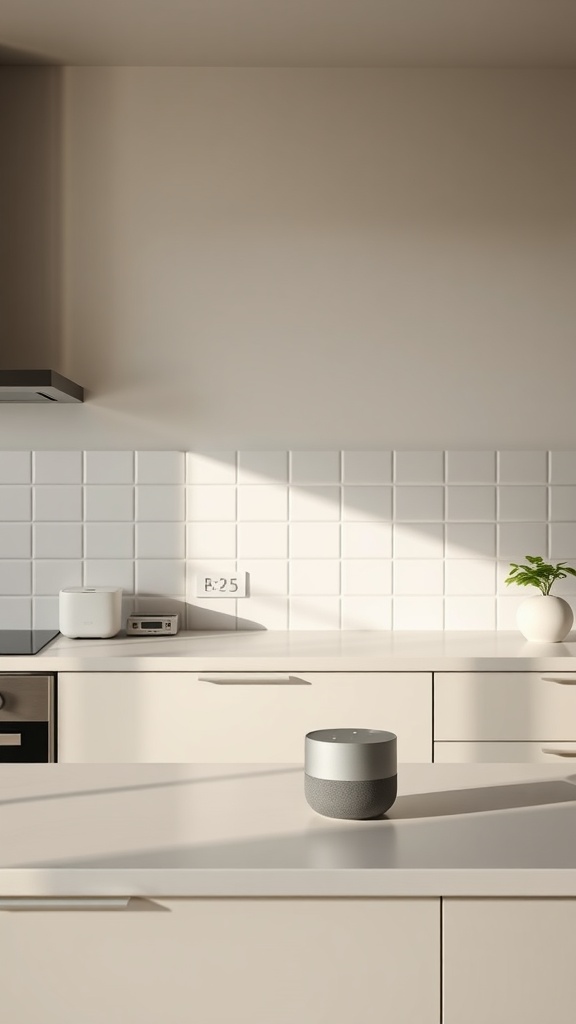
18. Discreet Technology
Choose devices in matte, muted finishes and hide the cables. In a minimal kitchen, visible wires are as disruptive as clutter.

19. A Clean-Lined Island
Keep the island top almost bare — a single bowl of fruit is enough. Its value in a minimal kitchen is as much clear surface as storage.

20. Subdued Pattern
A soft, low-contrast pattern in the textiles adds a hint of interest without breaking the calm. Keep it tonal so it reads as texture, not decoration.
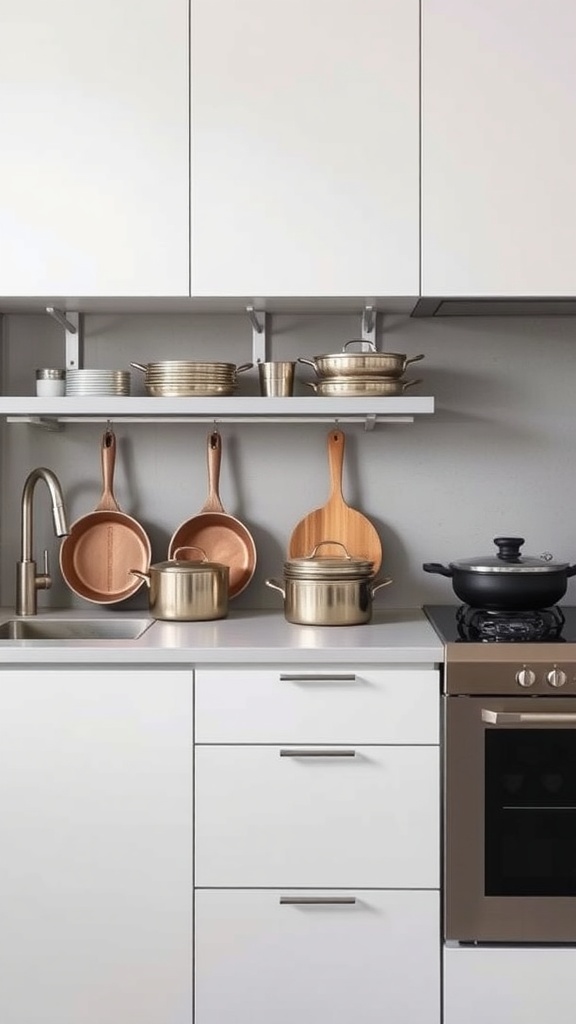
21. Considered Cookware on Show
If your pans are attractive and used daily, displaying them is honest minimalism. If they're mismatched or rarely used, they belong in a cupboard.

22. A Simple Backsplash
Plain subway tile or a single large-format panel keeps the wall calm and easy to clean. Minimal grout lines mean less visual noise and less maintenance.

23. Pared-Back Tableware
Plain white plates let the food be the colour. A single, well-chosen dinner set is more minimalist than several partial ones.

24. Texture, Not Clutter
The distinction that makes or breaks the style. A few tactile wooden and ceramic pieces add warmth; a crowd of objects, however nice, breaks the calm.
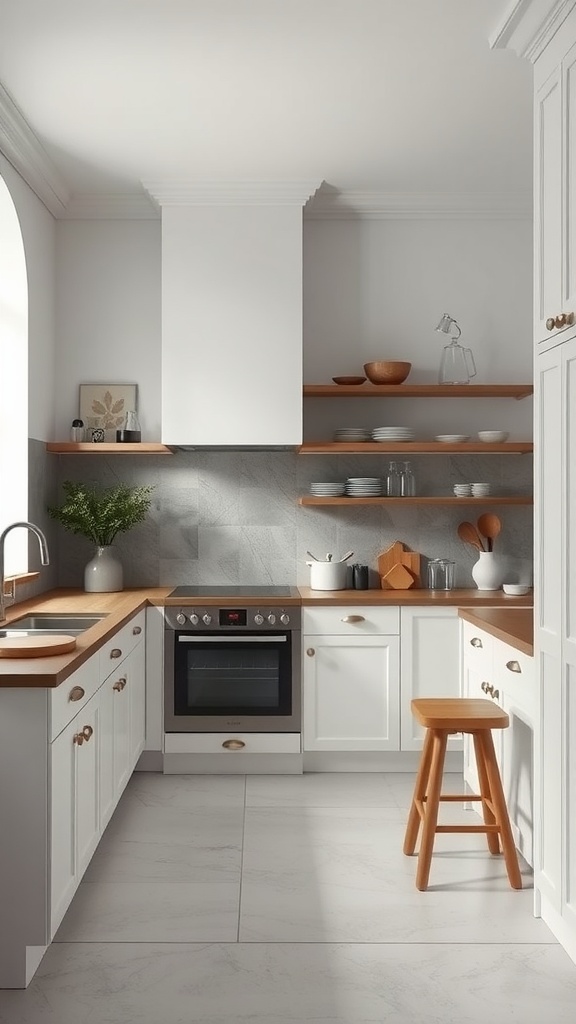
25. Timeless Choices
Classic forms and neutral materials date slowly, which suits minimalism's long-term outlook. Avoid trend finishes you'll tire of in a couple of years.

26. Geometric Storage
Clean geometric storage keeps everything in its place while reinforcing the room's structured, rectilinear character.

27. A Calm, Zen Atmosphere
The real reward of a minimalist kitchen: a low-stimulation space that's genuinely restful to be in. Clear surfaces reduce the visual noise your brain processes.

28. One Replaceable Accent
A single pop of colour — in a tea towel, a bowl, one object — keeps a minimal kitchen from feeling stark, and it's easy to change when you want a refresh.
Minimalist kitchen FAQ
How do I keep a minimalist kitchen from feeling cold? Warm wood, natural texture and 2700 K lighting. Cold minimalist kitchens almost always fail on those three, not on the cabinetry. The materials and the light do the warming, not colour.
What should I keep on a minimalist countertop? Ideally almost nothing — the largest stretch entirely clear for cooking, and only daily-use appliances or one small styled group on display. Everything used less than weekly belongs behind a door.
Is open shelving minimalist? It can be, if it's sparse and uniform — matching crockery, styled at half capacity, with real gaps. Crammed open shelves are the opposite of minimalist. If you can't keep it disciplined, closed cabinets are the safer choice.
How is minimalist different from just tidy? Tidy is about where things are stored; minimalist is about owning and displaying less in the first place. A tidy kitchen can still be full; a minimalist one is deliberately sparse.
Does a minimalist kitchen need special storage? Not special, but generous. Clear surfaces only exist if everything has somewhere to go, so plan for more concealed storage than you think you need — integrated appliances, pull-out drawers and full-height units all help.
How to get a minimalist kitchen without renovating
The best thing about a minimalist kitchen is that most of it costs nothing — because the work is subtractive. You can move a long way toward the look in an existing, even rented, kitchen without touching the cabinetry.
Start by clearing every surface. Take everything off the worktops, then put back only what you use at least weekly. This single free step gets you most of the way there — a decluttered counter reads as minimalist regardless of the cabinet style behind it.
Decant and unify. Transferring dry goods into matching containers and hiding branded packaging behind cupboard doors removes a surprising amount of visual noise. Uniformity is what makes even open storage read as calm.
Swap the hardware. If you can't change the doors, changing the handles is the next best thing — simple, matte, uniform hardware modernises dated cabinetry for very little, and it's usually reversible if you keep the originals.
Fix the lighting. Warm 2700–3000 K bulbs and a strip of under-cabinet light transform how a kitchen feels and reads. Cool white lighting is what makes a pared-back kitchen look clinical, and it's a five-minute change.
Edit the tableware. A single set of plain white crockery, replacing an accumulation of mismatched pieces, is one of the most minimalist changes you can make — and it makes food look better on the plate too.
Add back one thing. Finish with a single deliberate accent — a plant, a bowl of fruit, one piece of art. Minimalism isn't emptiness; it's one considered object with space around it.
Common minimalist kitchen mistakes
- Buying "minimalist decor" to add — minimalism is subtractive; the objects are the problem, not the solution.
- No texture — without wood, stone and tactile contrast, a minimal kitchen reads flat and cold.
- Cool white lighting — turns a pared-back kitchen clinical; stay at 2700–3000 K.
- Not enough concealed storage — clear surfaces are impossible without somewhere to hide the contents.
- Overfilled open shelves — the fastest way to undo the whole look.
Final thought
A minimalist kitchen is achieved by editing, not shopping. Decide that everything on show must be used, beautiful, or both; keep the surfaces clear; warm the pared-back palette with wood, texture and 2700 K light; and give everything else a place to go. What remains will feel calm and considered — which is the entire point of the style.

Sources & principles referenced
- Minimalism as a subtractive discipline (use/beauty filter for visible objects).
- Clear-worktop and weekly-use conventions.
- Texture and tonal contrast as substitutes for colour.
- Concealed and integrated storage, handleless cabinetry and pull-out drawers.
- The kitchen work triangle (1.2–2.7 m legs) and landing space.
- Layered warm lighting including under-cabinet task light (2700–3000 K).
- Pendant mounting height (75–90 cm).