
A small kitchen fails or succeeds on measurements, not decor. Get the layout, clearances and storage right and even a very tight galley works beautifully; get them wrong and no amount of styling will fix it. These 22 simple kitchen design ideas for small spaces are built around the numbers professional kitchen designers actually use — so you can plan a small kitchen that's genuinely efficient to cook in.
Start with the work triangle
The kitchen work triangle connects your three main stations — sink, hob and refrigerator — and it's the single most useful planning tool in kitchen design. The established guidance: each leg should be between 1.2 and 2.7 m (4–9 ft), and the three legs combined should total roughly 4–8 m (13–26 ft). Too tight and you're crowded; too spread out and you're walking unnecessarily. Keep the triangle clear of major traffic paths so people crossing the kitchen don't cut through your work zone.
In very small kitchens the triangle often collapses into a line — that's fine. In a single-wall or galley layout, aim instead for the classic sequence fridge → sink → hob, with worktop between each, which mirrors how you actually cook: fetch, prep, cook.
The clearances that make a small kitchen usable
- Walkway between runs: at least 107 cm (42 in) for one cook; 122 cm (48 in) if two people use it at once. Below about 91 cm (36 in) it becomes genuinely awkward.
- Worktop height: the standard is 91 cm (36 in) — worth adjusting if you're notably tall or short, since it affects comfort daily.
- Upper cabinets: hang about 45 cm (18 in) above the worktop so you keep usable prep space beneath.
- Landing space: leave at least 30–38 cm of clear worktop beside the hob and the fridge — this is where a small kitchen most often falls short.
Storage: go vertical and go deep
Small kitchens rarely lack space — they lack accessible space. Take cabinetry to the ceiling and store rarely used items on top shelves. Replace deep base cupboards with pull-out drawers, which let you reach the back without kneeling and typically increase usable capacity substantially. Use dedicated corner mechanisms for the dead corner, and put the wall to work with rails, hooks and slim open shelving.
Light and colour
Pale, reflective surfaces bounce light and make a compact kitchen read larger — light cabinetry, a light worktop and a glossy or semi-gloss backsplash all help. Just as important is under-cabinet task lighting: upper cabinets cast shadow exactly where you chop, and a strip of warm light beneath them fixes the most common lighting fault in small kitchens. Keep bulbs at 2700–3000 K for a kitchen that's practical to work in but still warm.
22 small kitchen ideas — and why each works

1. Compact Appliances
Slimline dishwashers, under-counter fridges and combination ovens reclaim significant volume in a tight kitchen. Measure your genuine needs before buying full-size — most households cook for fewer people than their appliances are sized for.

2. Organise Under the Sink
The under-sink cupboard is usually the worst-used space in the kitchen thanks to the plumbing. Tiered racks and clear containers work around the pipework and turn dead volume into genuinely accessible storage.

3. Multi-Functional Furniture
A table that doubles as prep space, or a bench with storage inside, earns its footprint twice. In a small kitchen every large item should justify itself with at least two functions.

4. Open Shelving
Open shelves feel lighter than upper cabinets and keep everyday items within reach. The trade-off is honest: they collect grease and dust, so reserve them for things you use often enough to wash regularly.

5. A Compact Breakfast Nook
A round table fits tight corners better than a rectangular one because there are no corners to catch as you pass. Two chairs and a small round top can occupy under a square metre while still functioning properly.

6. Light Cabinetry
Pale cabinets and worktops reflect light and visually recede, which makes the room read larger. It's the cheapest spatial gain available — often just a coat of cabinet paint.

7. Use the Full Height
Most kitchens waste the band between the top of the cabinets and the ceiling. Taking storage all the way up adds real capacity — put seasonal and rarely used items in the highest zone.

8. A Rolling Island
A trolley island gives you extra worktop when you need it and rolls out of the walkway when you don't. It's the only kind of island that makes sense when clearances are tight.

9. Layered Lighting
A small kitchen needs three layers: general ceiling light, under-cabinet task light where you actually chop, and something warm and decorative for the evening. One central fixture alone always leaves the worktop in shadow.

10. A Right-Sized Dining Set
Allow roughly 60 cm of table width per person and about 90 cm behind each chair to pull out and stand. Undersized seating that nobody can actually get into is worse than none.

11. Colour in the Accessories
Keep the large surfaces pale and let crockery, textiles and small appliances carry the colour. This way you get personality without visually shrinking the room — and you can change it any time.

12. A Working Triangle
Position sink, hob and fridge so each leg falls between 1.2 and 2.7 m, with worktop between them. This single decision affects how the kitchen feels to use more than any finish you choose.

13. A Mirror or Mirrored Splashback
Mirror bounces daylight and visually doubles the depth of a narrow kitchen. A mirrored splashback is easier to wipe clean than tile grout, though it does show every splash.
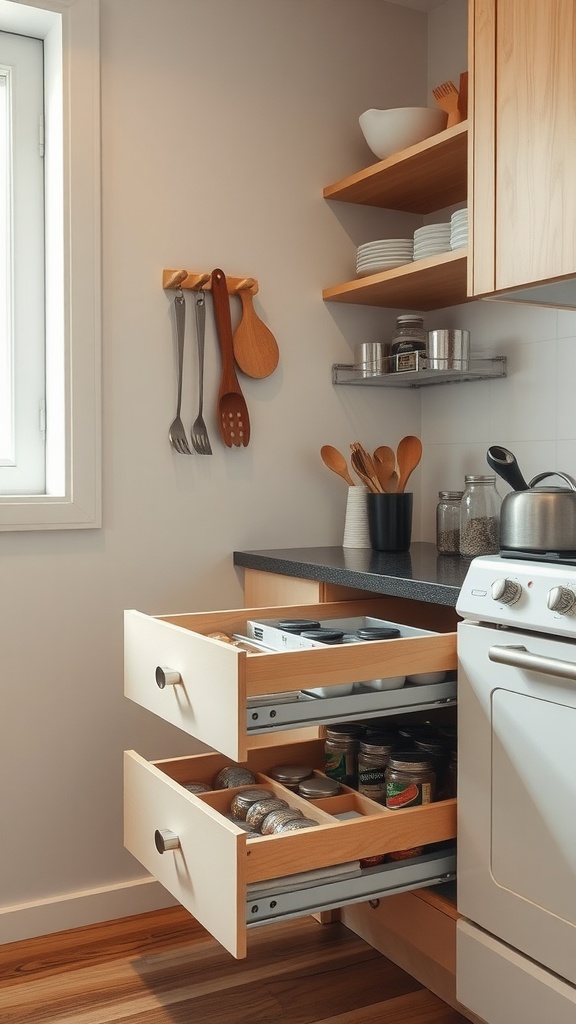
14. Pull-Out Drawers
Deep drawers beat deep cupboards decisively: everything comes to you rather than you reaching into the dark. If you change one thing about your storage, change base cupboards to drawers.

15. An Overhead Pot Rack
Hanging pans frees an entire cupboard and puts them within reach. Position the rack clear of head height in walkways — over an island or a run of worktop rather than a passing point.

16. Solve the Corner
The corner cabinet is the biggest wasted volume in most kitchens. A carousel, pull-out mechanism or open corner shelving turns unreachable depth into storage you'll actually use.
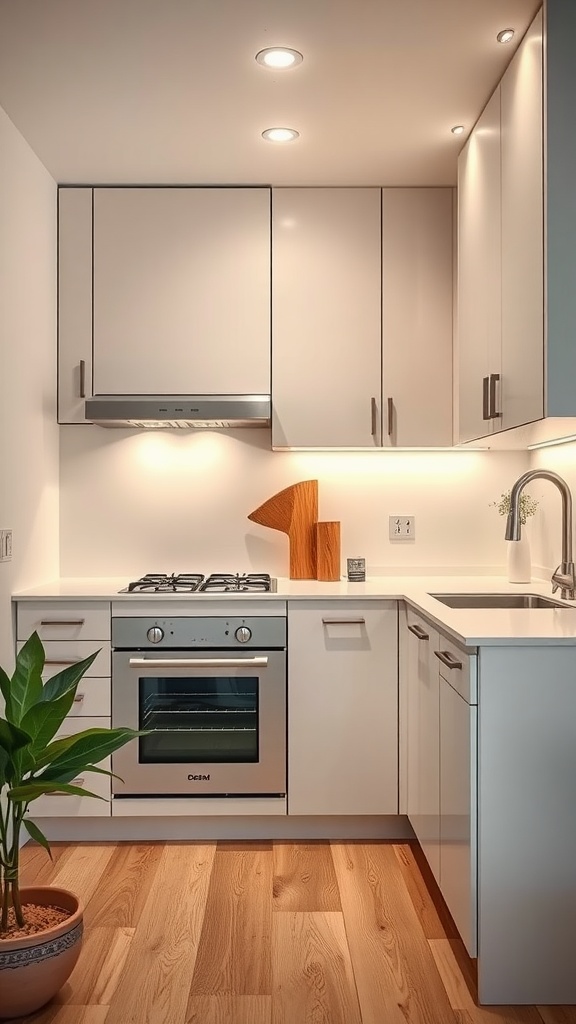
17. Integrated Appliances
Appliances behind matching cabinet fronts create an unbroken visual run, which makes a small kitchen feel calmer and larger. Fewer visual interruptions equals more perceived space.

18. Keep Worktops Clear
Clear counters are the strongest signal of a well-planned small kitchen — and they give you room to actually cook. Store everything you don't use daily and the space instantly feels bigger.

19. Maximise Daylight
Keep window treatments minimal — a blind or sheer rather than heavy curtains, which also collect cooking grease. Natural light does more for a small kitchen than any spatial trick.

20. Slimline Storage
Narrow pull-out larders as slim as 15 cm slot into gaps that would otherwise be filler panels. In a small kitchen, those overlooked centimetres add up fast.

21. A Fold-Down Worktop
A hinged extension gives you extra prep or dining surface on demand and disappears flat against the wall afterwards. Ideal where a permanent island simply won't fit the clearances.

22. A Windowsill Herb Garden
Herbs on the sill add greenery and are genuinely useful while you cook. It's the one bit of decor in a small kitchen that costs no worktop and pays you back.
Which layout suits a small kitchen?
Single-wall — everything along one run. Best for very narrow rooms and studios; arrange fridge, sink, hob in that order with worktop between, and add a trolley for extra surface.
Galley — two parallel runs. The most efficient small-kitchen layout because everything is within a step, provided you keep at least 107 cm between the runs. Put the hob and sink on the same side to avoid carrying hot pans across the walkway.
L-shape — two adjoining walls. Excellent for small kitchens because it creates a natural triangle and keeps traffic out of the work zone, while leaving room for a small table in the free corner.
U-shape — three walls. Superb storage and worktop, but it needs enough width to keep the clearance between opposite runs comfortable, so it's the first layout to rule out in a genuinely tight room.
Small kitchen FAQ
What's the minimum size for a functional kitchen? A single-wall kitchen can work in as little as 2.4 m of run, provided you get the sequence right (fridge, worktop, sink, worktop, hob) and keep at least 91 cm of clear floor in front of it. What matters far more than total area is having landing space beside the hob and the sink.
Should I choose open shelving or wall cabinets in a small kitchen? Cabinets store more and hide clutter, which usually wins in a genuinely small kitchen. Open shelving feels lighter and more spacious but demands discipline and regular cleaning. A common compromise is cabinets on the main run and one short stretch of open shelving where it will be seen but not splashed.
How do I make a small kitchen look bigger? In order of impact: keep worktops clear, use light reflective surfaces, run cabinetry to the ceiling, add under-cabinet lighting, and reduce visual interruptions by integrating appliances behind matching fronts. Clutter shrinks a kitchen faster than any architectural constraint.
Is an island possible in a small kitchen? Only if you can keep 91 cm of clearance all the way around it, which most small kitchens can't. A rolling trolley or a fold-down worktop extension gives you the extra surface without permanently blocking the walkway.
Where should the bin go? Directly beside or under the sink, since that's where prep waste is generated. An integrated pull-out bin inside a base unit keeps the floor clear — in a small kitchen a freestanding bin is almost always in the way.
Common small kitchen mistakes
- No landing space beside the hob or fridge — you need somewhere to set things down; this is the most common planning failure.
- Walkways under 91 cm — doors and drawers can't open properly and two people can't pass.
- Cluttered worktops — the fastest way to make a small kitchen unusable and feel even smaller.
- Only a ceiling light — upper cabinets shadow the worktop; under-cabinet lighting is close to essential.
- Deep base cupboards — the back third becomes inaccessible; drawers solve this.
Final thought
Small kitchens reward planning far more than decorating. Fix the triangle, protect your clearances, convert cupboards to drawers and light the worktop properly — then keep the surfaces clear and the palette light. Do that and a compact kitchen will out-perform a large, badly planned one every time.

Sources & principles referenced
- The kitchen work triangle (leg lengths of 1.2–2.7 m; combined 4–8 m).
- Standard kitchen clearances (107–122 cm walkways), worktop height (91 cm) and upper-cabinet mounting height (45 cm).
- Landing-space requirements beside hob and refrigerator.
- Single-wall, galley, L- and U-shaped layout characteristics.
- Layered kitchen lighting including under-cabinet task light (2700–3000 K).